
Medical malpractice cases in Washington, D.C. are difficult, expensive, and heavily defended. Hospitals, doctors, and insurance companies rarely concede liability unless the evidence is strong. Even when a patient has suffered a terrible injury, the plaintiff still must prove that the healthcare provider violated the standard of care and that the violation caused the harm.
That is why actual trial verdict data is useful.
The D.C. Superior Court has published annual medical malpractice trial verdict summaries for a number of years. These forms do not provide full case narratives. They generally list the trial date, case year or case number, broad claim category, injury category, plaintiff’s last known demand, defendant’s last known offer, verdict result, and verdict amount.
The publicly available forms reviewed for this article cover the years 2007 through 2014 and 2016 through 2019. A 2015 form does not appear to have been published, and no public forms have been located for years after 2019, so the figures below reflect only those reporting years.
The reports are limited. They do not identify the patient, the healthcare provider, the hospital, the expert testimony, or the full medical facts. They also do not include all settlements. Still, they provide a valuable public window into how difficult these cases are — and how significant the verdicts can be when a plaintiff proves medical negligence caused serious harm.
The following list summarizes ten of the largest plaintiff medical malpractice verdicts reflected in the available D.C. Superior Court annual verdict forms reviewed for this article.
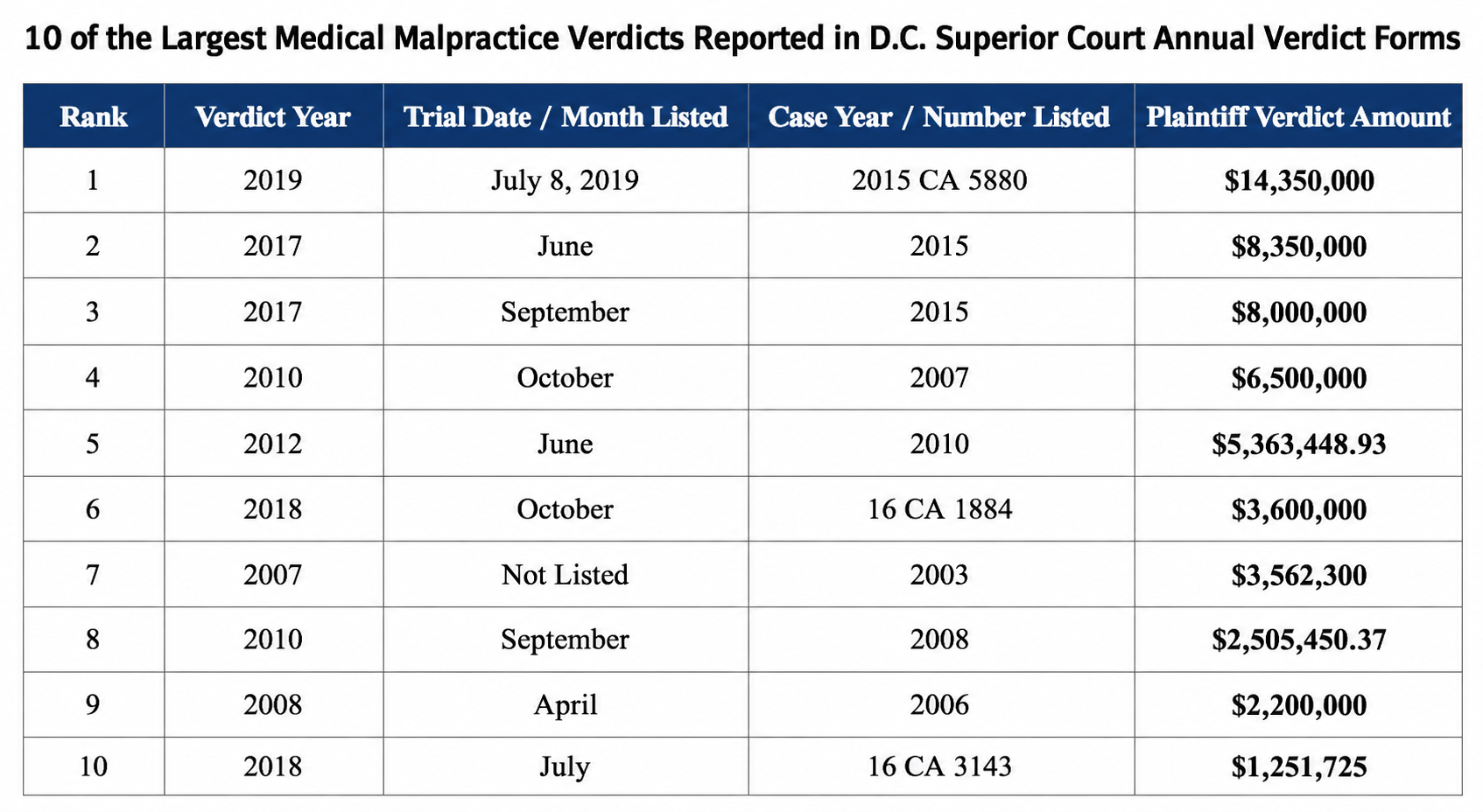
These numbers should be read with care. A verdict is not the same thing as a guaranteed final recovery. Post-trial motions, appeals, remittitur, settlement, liens, and collection issues can affect what ultimately happens after a verdict. The forms are also annual summary documents, not complete case files, and — as the footnotes above show — some entries contain internal inconsistencies.
Even with those limitations, the verdict data tells an important story.
Medical Malpractice Plaintiffs Usually Face an Uphill Battle
The same annual reports show that defense verdicts are common in D.C. medical malpractice trials. Across the reporting years reviewed, defendants prevailed far more often than plaintiffs. That is not surprising. Medical malpractice cases are technical. Jurors must hear from competing medical experts. The defense will almost always argue that the care was reasonable, that the injury was an unavoidable complication, or that the outcome would have occurred even with perfect care.
For an injured patient, it is not enough to show that something went wrong. The plaintiff must prove negligence and causation.
That burden explains why careful screening is critical. A responsible medical malpractice lawyer must obtain the records, identify the timeline, consult the right experts, and determine whether the medicine supports a claim before filing suit.
The Largest Verdicts Tend to Involve Serious or Permanent Harm
The annual forms classify injuries in broad categories such as fatality, serious permanency, non-serious permanency, no permanency, or not specified. Although the forms do not describe the underlying facts in detail, the larger verdicts generally appear in cases involving serious injury, permanent injury, death, or high-stakes damages.
That fits what experienced malpractice lawyers see in practice. The most economically viable cases usually involve major injury, such as:
- Brain injury
- Birth injury
- Stroke
- Paralysis
- Blindness
- Severe surgical injury
- Permanent neurological damage
- Loss of function
- Wrongful death
- Major life-care needs
A minor injury may still matter deeply to the patient, but medical malpractice litigation is expensive. Expert review, depositions, medical literature, trial preparation, and courtroom presentation can cost a great deal. For that reason, cases involving catastrophic or permanent harm are more likely to justify the investment required to take on a hospital, physician group, or insurance carrier.
The 2019 Verdict Report included a Reported $14.35 Million Plaintiff Verdict
The largest plaintiff verdict figure in the available annual forms reviewed was a reported $14.35 million in 2019. The 2019 form listed only three medical malpractice trial verdicts that year: two for plaintiffs and one for the defendant. The form’s summary identifies $14.35 million as the highest plaintiff verdict, although — as noted above — the itemized rows on that form do not separately reflect that amount.
Read with that caveat, the figure is still a reminder that D.C. juries can return substantial awards when the evidence supports liability and damages.
The 2017 Verdict Report Was Unusual
The 2017 report was notable because it listed six trials resulting in verdicts, with four plaintiff verdicts and two defense verdicts. Two of the plaintiff verdicts were especially large: $8.35 million and $8 million.
That is not the usual pattern. In most years, defense verdicts outnumber plaintiff verdicts. The 2017 data, therefore, stands out as an unusually strong plaintiff year in the available reports.
The 2010 and 2012 Reports Also Included Multimillion-Dollar Plaintiff Verdicts
The 2010 report included two plaintiff verdicts, including one for $6.5 million and another for approximately $2.5 million ($2,505,450.37).
The 2012 report included a plaintiff verdict of approximately $5.36 million ($5,363,448.93). That verdict exceeded both the plaintiff’s last known demand of $5 million and the defendant’s last known offer of $1.25 million as reflected in the annual form.
These examples show that when a plaintiff has strong liability, strong causation, and serious damages, D.C. medical malpractice verdicts can reach into the multimillion-dollar range.
What Verdict Data Does Not Tell You
Verdict reports are useful, but they do not answer the most important question for a new client: “Do I have a case?”
A medical malpractice case depends on the medicine and the proof. The value of a case depends on many factors, including:
- What the medical records show
- Whether the provider violated the standard of care
- Whether the negligence caused the injury
- Whether the injury is permanent
- Whether there are major medical expenses or future care needs
- Whether the patient lost wages or earning capacity
- Whether the case involves death, brain injury, birth injury, or other catastrophic harm
- Whether qualified experts will support the claim
- Whether the defense has strong causation arguments
Two cases may look similar on the surface but have very different legal value after expert review.
Past Verdicts Do Not Guarantee Future Results
No one should assume that a prior verdict predicts the outcome of a future case. Every case turns on its own facts, records, witnesses, experts, medicine, and damages.
Some catastrophic injury cases are not malpractice cases. Some clear medical errors do not cause enough damage to justify litigation. Some meritorious cases settle before trial. Some strong cases lose at trial because juries are unpredictable.
The value of verdict data is not that it predicts a specific outcome. Its value is that it shows the range of outcomes in real cases that went to verdict in the D.C. Superior Court.
Why You Need a Lawyer Who Understands Both Medicine and Litigation
Medical malpractice cases are different from ordinary personal injury cases. They require a detailed understanding of medicine, hospital systems, expert testimony, causation, damages, and trial strategy.
A strong medical malpractice case usually requires:
- Complete medical records
- A detailed chronology
- Review by qualified specialists
- Identification of the applicable standard of care
- Proof that the standard of care was violated
- A causation analysis connecting the negligence to the injury
- A damages analysis showing the full impact of the harm
Hospitals and insurance companies do not pay substantial compensation simply because a patient had a bad outcome. They pay when the evidence shows negligence, causation, and serious damages.
Contact a Washington, D.C. Medical Malpractice Lawyer
If you or a family member suffered a serious injury because of suspected medical negligence in Washington, D.C., our office can evaluate whether you may have a viable claim.
We handle complex medical malpractice cases involving:
- Birth injuries
- Brain injuries
- Hospital negligence
- Surgical errors
- Delayed diagnosis
- Emergency department negligence
- Medication errors
- Failure to monitor
- Failure to treat
- Wrongful death
A prompt investigation is important. Medical records must be obtained and reviewed. Expert opinions must be developed. Legal deadlines may apply.
Contact Our Washington, D.C. Medical Malpractice Lawyers at the Law Offices of Dr. Michael M. Wilson, M.D., J.D. & Associates Today
While medical negligence is one of the more challenging areas of law, having the right legal counsel in your corner can significantly improve the outcome. At the Law Offices of Dr. Michael M. Wilson, M.D., J.D. & Associates, our Washington, D.C. medical malpractice lawyers represent clients injured by medical negligence. Call 202-223-4488 or contact us online to schedule a free consultation. Located in Washington, D.C., we serve clients in the surrounding areas, including Northern Virginia and Maryland.
________________________________________________________________________________________
Source Support
Figures are drawn from the D.C. Superior Court annual medical malpractice trial verdict forms reviewed for this article. The 2019 form reports a highest plaintiff verdict of $14,350,000 (subject to the row inconsistency noted above); the 2017 form reports four plaintiff verdicts, including $8,350,000 and $8,000,000; the 2010 form reports plaintiff verdicts of $6,500,000 and $2,505,450.37; the 2012 form reports the $5,363,448.93 plaintiff verdict; the 2018 form reports plaintiff verdicts of $3,600,000 and $1,251,725; the 2007 form reports a highest plaintiff verdict of $3,562,300; and the 2008 form reports a highest plaintiff verdict of $2,200,000 (subject to the inconsistency noted above). Available public forms span 2007–2014 and 2016–2019; no 2015 form and no post-2019 public forms were located.